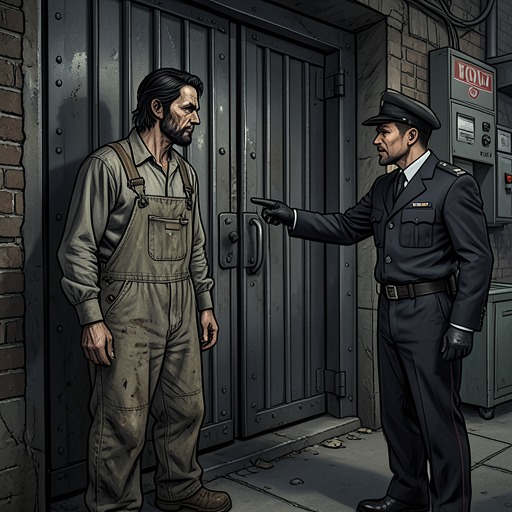
Ralph Myers recants his accusation against Walter McMillian
Just MercyRalph Myers recants his accusation against Walter McMillian when he retracts the testimony that had made him the prosecution’s central witness in the Ronda Morrison murder case. His account changes first in a meeting with Bryan Stevenson and then, under oath, in court: Myers says he lied, denies that any allegation against McMillian was true, and stands by the recantation through questioning. The reversal gives the defense a direct challenge to the case that placed McMillian on death row, while exposing how racial assumptions and courtroom practice shaped the conditions under which that case was tried.
Background: A case built around disputed testimony
By February 1988, the prosecution was preparing to try McMillian in Monroe County. After being removed from death row and returned to the county, Myers had reaffirmed his original accusations. The district attorney believed he could proceed with Myers as the principal witness and Bill Hooks ready to testify that he had seen McMillian’s truck at the crime scene. The accusations were contested, and many Black residents believed McMillian was innocent, but District Attorney Ted Pearson remained confident he could secure a guilty verdict.
The defense’s later investigation produced concrete reasons to question the story. A storeowner recalled that Myers had asked which of several Black men in his store was McMillian—evidence that Myers had not known McMillian before. A flyer preserved by a white storeowner confirmed that the fish fry at McMillian’s house had taken place on the day of the murder. The mechanic who modified McMillian’s truck confirmed that its conversion to a low-rider happened more than six months after the crime, contrary to the distinctive truck description given at trial. These findings did not themselves constitute Myers’s recantation, but they sharpened the conflict between the prosecution’s account and the details investigators were uncovering.
The case also sat within a wider history of racial control. In 1987, all forty elected district attorneys in Alabama were white, despite the state having sixteen majority-Black counties. Monroe County was 40 percent Black, yet defendants in counties with large Black populations still often faced all-white juries. Although the Supreme Court of the United States had ruled in Batson v. Kentucky in 1986 that prosecutors could be challenged for racially discriminatory peremptory strikes, the ruling did not ensure that Black jurors would serve. McMillian, already concerned about the jury he might face, was confronting a prosecution whose key testimony came from Myers and Hooks, both witnesses whose accounts had drawn serious doubts.
The private reversal
As the investigation progressed, Stevenson received a call from a person introduced by the office secretary as “Mr. Miles.” The caller identified himself as Ralph Myers. Stevenson was startled; before he had time to settle himself, Myers spoke again. When Myers arrived, he looked skeptically at Michael O’Connor, then slowly sat down. Stevenson intended to ease him into a conversation about telling the truth, but Myers began with a full retraction before Stevenson could start.
“I lied. Everything I said at McMillian’s trial was a lie. I’ve lost a lot of sleep and have been in a lot of pain over this. I can’t be quiet any longer.” The declaration reversed the role Myers had occupied in the prosecution: rather than supplying the accusation on which the case depended, he now said that his trial account had been fabricated. Stevenson asked cautiously whether Myers meant the testimony against McMillian had been a lie. The account emphasizes Stevenson’s care in responding; he feared that showing too much surprise or eagerness might cause Myers to retreat. The recantation arrived as a consequential break in the case, but it still had to withstand the demands of a courtroom.
Testimony under examination
At the evidentiary hearing, Stevenson established on the record that Myers had previously appeared in court and testified against McMillian. He then asked, “Mr. Myers, was the testimony that you gave at Mr. McMillian’s trial true?” Myers looked at him coolly and answered clearly: “Not at all.” The response prompted murmuring in the courtroom. Stevenson repeated the words before continuing, giving the answer space to register while making clear that more evidence was needed.
When Stevenson asked whether any of Myers’s allegations connecting McMillian to the murder were true, Myers paused, looked around the courtroom, and answered, “No.” This time, his voice carried emotion that the narration describes as regret or remorse. Stevenson then took him through the trial transcript statement by statement. Myers acknowledged that his earlier testimony was entirely false and described being coerced to testify falsely. He remained calm when asked to repeat those parts of his account, frequently turning to look Judge Norton directly in the eye. He also held to the recantation during lengthy cross-examination by prosecutor Tom Chapman, becoming indignant when Chapman suggested that someone had put him up to changing his testimony.
The courtroom and the limits of a reversal
The hearing’s significance was sharpened by the unequal conditions surrounding it. On a subsequent court day, Stevenson found that the courtroom entrance had been changed: a large metal detector stood inside the door, with a German shepherd held by a police officer beyond it. The benches previously occupied by McMillian’s supporters were now mostly filled with older white people supporting the Morrisons and the prosecution. McMillian’s family and supporters had been told they could not enter, although supporters of the State had been admitted. Stevenson challenged the restriction with Chapman and then brought the matter to Judge Norton. The recantation had put the prosecution’s evidence in question, but the scene also showed that access to the courtroom and the appearance of public support remained contested.
The reversal gains force from its progression: an investigation finds specific conflicts in the prosecution’s account; Myers calls and confesses privately; then he repeats the denial in court, where his former testimony can be compared line by line with his new account. The episode does not, by itself, establish the case’s final outcome. Its decisive consequence is narrower and more immediate: the prosecution’s principal witness repudiates every allegation he had made against McMillian, and does so in a setting where the defense can test that repudiation in public. The recantation exposes how a verdict built on testimony can become unstable when the witness who supplied it says that it was false.